

The Ultimate Guide to Wireless Chargers in 2026: Qi, Qi2, Mag Safe, and Fast Wireless Charging Explained Charging Explained
Wireless charging has gone from a luxury feature to an everyday necessity. Whether you’re using an iPhone, Samsung Galaxy, or Google Pixel, a wireless charger offers a cleaner desk setup, less cable clutter, and long-term convenience.
But with so many options — Qi wireless charging, Qi2 wireless charging, MagSafe chargers, 15W wireless chargers, magnetic wireless chargers, and multi-device wireless charging stations — choosing the best wireless charger can feel overwhelming.
This guide explains everything you need to know before you buy.
What is wireless charging?
Wireless charging uses electromagnetic induction to transfer power from a charging pad or stand to your phone without a cable. Most modern smartphones support Qi wireless charging, a global standard developed by the Wireless Power Consortium.
Instead of plugging in a cable, you place your phone on a wireless charging pad or stand.
Qi vs Qi2 Wireless Charging: What’s the Difference?
Qi Wireless Charging
Qi is the original global standard. It works with:
iPhone Wireless Charger Setup
Samsung Wireless Charger Models
Google Pixel Wireless Charger Options
AirPods Wireless Charging Cases
Qi chargers typically offer 5W to 15W of fast wireless charging, depending on the device and power adapter.
Older Qi chargers, however, required perfect alignment. If your phone wasn’t positioned correctly, charging speeds would slow down and heat would build up.
Qi2 Wireless Charging
Qi2 wireless charging introduces magnetic alignment — similar to MagSafe — ensuring perfect positioning every time.
Qi2 Benefits:
Continuous 15W fast wireless charging
Improved energy efficiency
Reduced heat generation
Universal magnetic compatibility
If you’re looking for the best wireless charger for 2026, Qi2 models are at the forefront of the market.
What is a MagSafe charger?
A MagSafe charger, which Apple introduced with the iPhone 12 series, uses built-in magnets to charge your iPhone at its best.
Benefits:
Magnetic wireless charger alignment
Stable 15W wireless charging performance
Ecosystem of devices (stands, wallets, mounts)
There are two types:
Made for MagSafe (official 15W support)
MagSafe compatible charger (may limit charging to 7.5W)
For iPhone users, the MagSafe charger is one of the best wireless charging solutions.
Types of Wireless Chargers
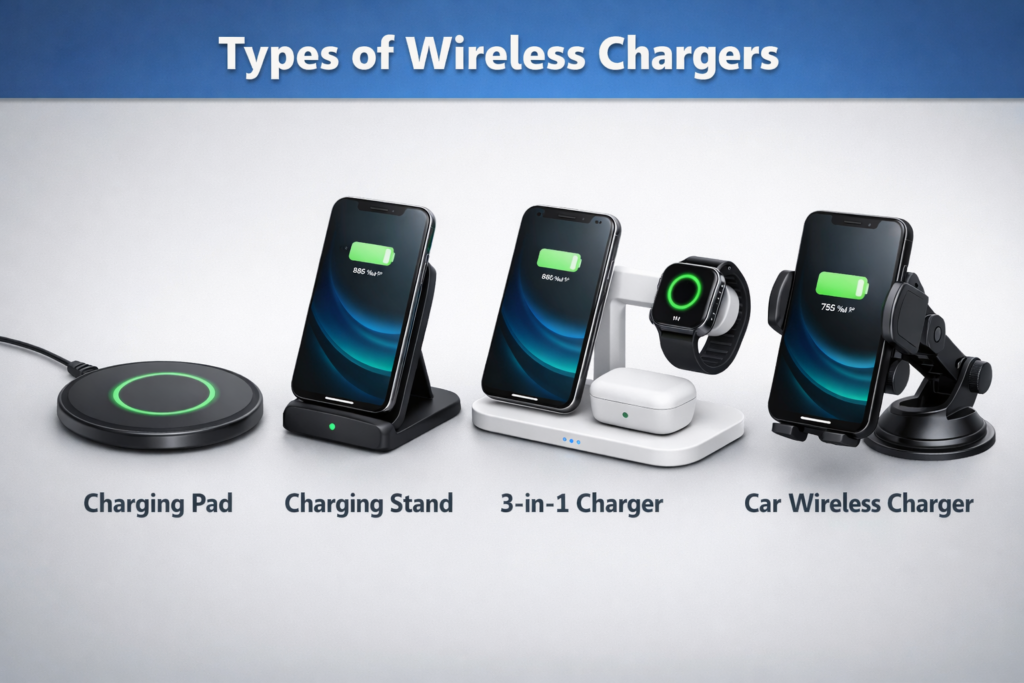
1. Wireless Charging Pad
A flat surface is ideal for bedside tables or desks.
Perfect for a minimalist setup.
2. Wireless Charging Stand
Keep your phone upright so you can see notifications while charging.
Perfect for office desks.
3. Wireless Charging Station
Charges multiple devices simultaneously. A 3-in-1 wireless charging station can power:
Phone
Apple Watch charger module
AirPods wireless charging case
Great for users of the Apple ecosystem.
4. Portable Wireless Charger
A foldable wireless charger or power bank with wireless charging is great for travel.
How fast is fast wireless charging?
Speed depends on wattage and compatibility:
5W – Standard wireless charging
7.5W – Older iPhone models
10W–15W – Fast wireless charger range
25W – Superfast wireless charging (select Samsung models)
To get the most speed:
Use a USB-C wireless charger.
Pair it with a 20W+ power adapter.
Choose a Qi-certified charger.
Wired vs. Wireless Charging: Which is Better?
Wired charging (USB-C Fast Charging) is still fast, often delivering 30W–120W depending on the phone.
However, wireless charging offers:
Convenience
Reduced port wear
Cleaner workspace
Easy overnight charging
For everyday use, a 15W wireless charger provides more than enough speed.
Does wireless charging damage your battery?
Modern Qi2 and MagSafe chargers are optimized for performance and temperature control.
A high-quality Qi-certified charger includes:
Overheat protection
Foreign object detection
Automatic power regulation
Wireless charging generates slightly more heat than wired charging, but premium models are designed to protect battery health.
How to choose the best wireless charger.
1. Check for compatibility.
Make sure your device supports Qi or Qi2 wireless charging.
2. Choose the right power output.
If your phone supports 15W fast wireless charging, don’t settle for 5W.
3. Consider your setup.
Desk use → Wireless charging stand
Nightstand → Wireless charging pad
Apple ecosystem → 3-in-1 wireless charging station
Travel → Foldable wireless charger
4. Look for certifications.
Always choose a Qi-certified charger to ensure safety and performance.
Best Wireless Chargers for 2026: What to Look for
When shopping for the best wireless chargers for 2026, prioritize:
Qi2 magnetic wireless charger support
15W or 25W fast wireless charging
Multi-device wireless charging station functionality
Case-compatible wireless charger design
Compact and portable build
Affordable wireless charger options are widely available, but premium wireless chargers offer better heat management and durability.
Are wireless chargers worth it?
Absolutely. Wireless charging is no longer just a premium feature — it’s becoming the standard.
With Qi2 wireless charging now available on all Android and iPhone devices, magnetic wireless chargers are now faster, safer, and more efficient than ever.
If you value:
Convenience
Cable-free charging
Multi-device organization
Modern desk aesthetics
Then investing in the best wireless charger for your needs makes perfect sense.
Final Thoughts
Wireless charging technology has matured significantly. Whether you choose a Qi wireless charging pad, MagSafe charger, or Qi2 magnetic wireless charger, today’s options provide reliable fast wireless charging for everyday use.
While wired charging remains the speed champion, a 15W wireless charger offers the perfect balance between performance and convenience.
As we move further into 2026, Qi2 wireless charging is poised to dominate the market – now is the perfect time to upgrade your charging setup.
Home Page : Tech In Sites


